


My Bible reading plan currently has me in Ecclesiastes. I’m not sure if you’ve ever read this book, but it’s not usually the go-to for daily encouragement! However, I’ve found myself really enjoying it more than I expected. I’ve been slowing down and trying to get to the WHY behind these writings.
This book is written by Solomon, who was the son of King David. Solomon wrote Proverbs, Song of Solomon and Ecclesiastes, which are referred as wisdom literature. He writes from his own life experiences, as he reflects on his up’s and down’s in life. He was a man who not only experienced a lot, but had a lot throughout his lifetime. These experiences led him to take a step back and take an honest reflection of life, which we read about in Ecclesiastes. It’s an authentic look at how fleeting this life is – how we should prioritize eternal things, while also enjoying each day we’ve been given as God desires for us.
Let’s zone in on these verses:
Ecclesiastes 7:15-18
In my futile life I have seen everything: someone righteous perishes in spite of his righteousness, and someone wicked lives long in spite of his evil. Don’t be excessively righteous, and don’t be overly wise. Why should you destroy yourself. Don’t be excessively wicked, and don’t be foolish. Why should you die before your time? It is good that you grasp the one and do not let the other slip from your hand. For the one who fears God will end up with both of them.
In my Bible, the title for this section of Scripture is called Avoiding Extremes.
What are extremes? Well, it’s when we camp out in a specific leaning, bias, thought, or view – so much that it begins to drive our worldview and actions. We begin to see everything through that view, and project that onto others.
Solomon uses strong imagery in these verses to make his point clear (using the phrase being excessively and overly righteous or wicked). He’s comparing two opposite lifestyles, and telling his readers to avoid boasting in extreme’s. He’s not saying literally to be wicked and not righteous, he’s just trying to paint a picture that our extreme views outside of following God’s heart and walking with Him, will eventually fade away. These extreme’s won’t last.
Are all extremes wrong? Not necessarily. However, because of sin, our tendency is often to take positions and run with them too far. The purpose here is not to list all of the extreme’s we could or do use, but rather to encourage each of us to consider our own struggle and move forward from there.
I would make the argument that as a Christian, the only extreme that should drive every view, belief, thought, and action that we have is the gospel of Jesus Christ.
Consider what Paul says about this:
1 Corinthians 2:1-5
When I came to you, brothers and sisters, announcing the mystery of God to you, I did not come with brilliance of speech or wisdom. I decided to know nothing among you except Jesus Christ and him crucified. I came to you in weakness, in fear, and in much trembling. My speech and my preaching were not with persuasive words of wisdom but with a demonstration of the Spirit’s power, so that your faith might not be based on human wisdom but on God’s power.
Paul’s message had nothing to do with his education, past accomplishments, upbringing, religion, intelligence, or anything else. He humbled himself in his preaching so much that he gave all of the credit to the Spirit working through him and simply pointed to the death and resurrection of Jesus Christ as his main message. Everything else he strived to say and do, flowed from that truth. Now, Paul also addressed some really hard issues in really difficult places. He didn’t turn away from the questions with all the people and churches he led, but He did so with truth, grace and love, and always brought people back to the Gospel.
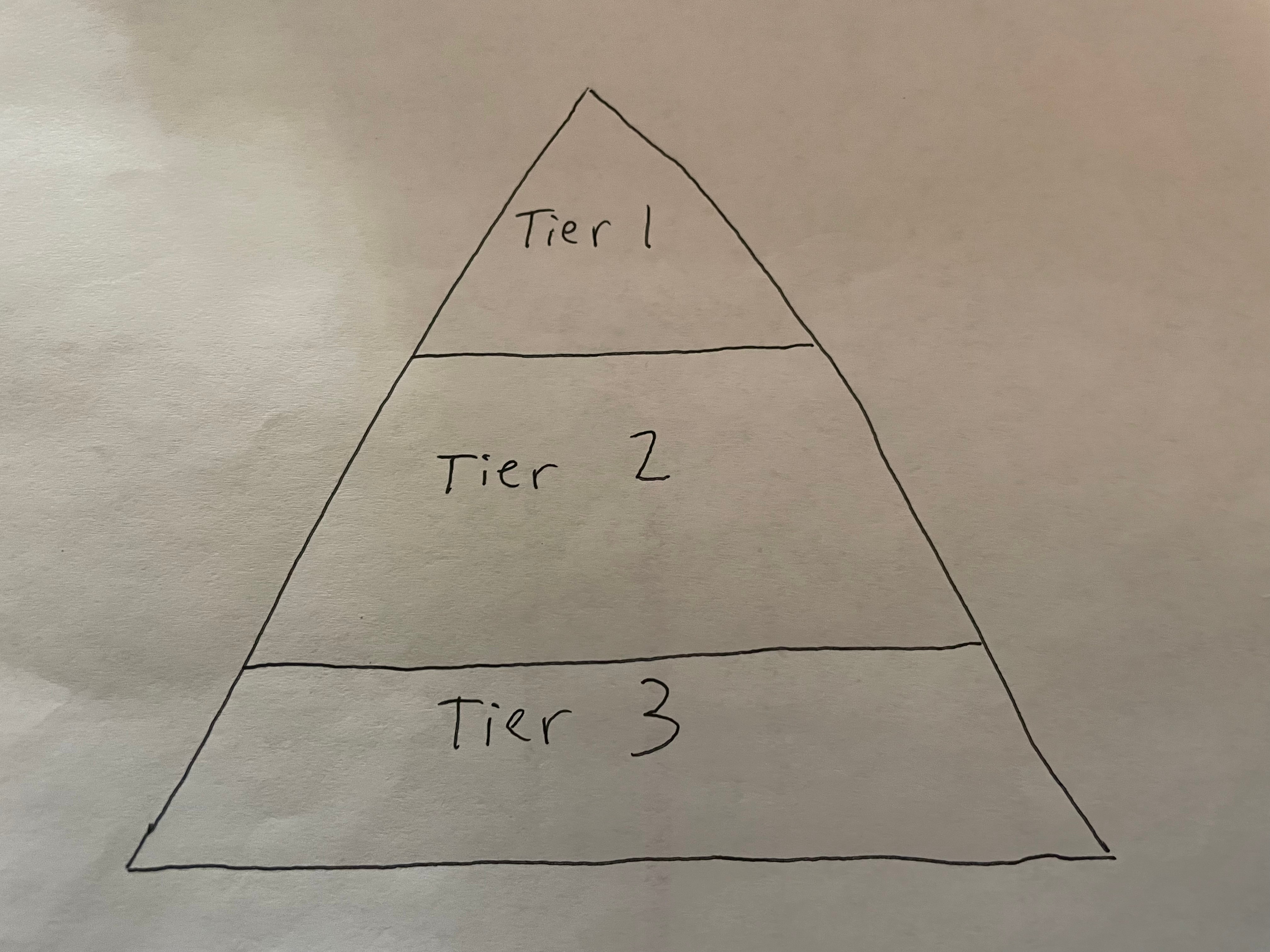
Check this out! This is called the theological triage. And no, I didn’t make this up; I stole it from someone way smarter than me! You will see Tier 1, Tier 2, and Tier 3. The lower the triangle gets, obviously the broader it becomes.
Here is what each layer means:
Tier 1: Topics that every Christian should agree on. Non negotiable – closed handed issues of the faith.
Tier 2: Topics that Christians can disagree on, but still have fellowship because they agree on the tier 1 topics.
Tier 3: Topics that we definitely should not divide over, that should not be extreme’s and can easily distract us from the main things (tier 1).
From Solomon, to Paul, to us today – nothing has changed. We have a tendency to take topics and camp out in them so much that we often think everyone else is wrong. From political views, tier 2 or 3 theological issues, education views, career views, athletic views, family views….you name it! As a Christian though, each of these other views and our opinions should be filtered through the Gospel, and then applied. We need humility, and we need wisdom from the Holy Spirit and each other.
So, the next time you and I are tempted to make something an extreme that shouldn’t be – let’s take a step back, check our hearts, and make sure we are putting Christ and His message to action over anything and letting that drive everything else!
Grace & Peace
 Matthew Weaver
Leave a comment